Search News
Industry Portal
Hot Articles
- How South Korea and China differ in shipbuilding intelligenceShipbuilding intelligence South Korea vs. China: compare engineering depth, smart-yard scale, green propulsion, supply chains, and delivery risk for smarter maritime investment decisions.
- Where does intelligence deliver value in the shipbuilding supply chain?Shipbuilding intelligence supply chain insights reveal how to reduce design risk, strengthen sourcing, meet compliance demands, and improve lifecycle value.
- How container AGV battery charging affects fleet availabilityContainer AGV battery charging directly shapes fleet availability. Learn how smart charging, battery health, reliable connectors, and data-led maintenance reduce downtime.
Popular Tags
Industry NewsMarine Propulsion Systems: Fuel Cost Tradeoffs in Newbuild Planning
Author
Prof. Kaelen SterlingTime
May 22, 2026Click Count
For finance approvers evaluating newbuild investments, marine propulsion systems are no longer a pure engineering choice—they are a long-term fuel cost, compliance, and asset-risk decision. From LNG and methanol to conventional low-speed diesel platforms, each propulsion pathway reshapes operating margins, retrofit exposure, and carbon readiness. This article outlines the core fuel cost tradeoffs that matter most in capital planning.
The core search intent behind “marine propulsion systems” in this context is practical decision support. Readers are not looking for a technical catalog alone. They want a finance-oriented framework to compare propulsion options in a newbuild program.
That means the most valuable answer is not a broad history of engines. It is a clear explanation of how fuel choice affects lifetime cost, regulatory exposure, vessel earnings, and residual asset value under changing carbon rules.
For finance approvers, the central question is simple: which propulsion pathway protects cash flow best over the next ten to twenty years, without creating avoidable retrofit, compliance, or chartering risk later?
What finance approvers really need to know before selecting marine propulsion systems

In newbuild planning, propulsion decisions should be treated as capital allocation choices under uncertainty. The engine room affects far more than bunker consumption. It influences financing terms, insurance confidence, charter appeal, and future upgrade cost.
Many internal discussions still begin with capex premium versus conventional low-speed diesel. That is too narrow. The correct comparison is total economic exposure across five areas: fuel cost, efficiency, compliance cost, downtime risk, and future marketability.
A vessel that is cheaper to build can become more expensive to own if it faces carbon penalties, lower charter rates, or an early need for fuel-system retrofits. A vessel with higher initial capex can outperform if it preserves commercial flexibility.
So the overall judgment is this: there is no universally cheapest propulsion choice. The best decision depends on route profile, fuel access, charter strategy, regulatory horizon, and the owner’s tolerance for fuel-price volatility.
Why fuel cost tradeoffs are not just about bunker price
Fuel is the largest variable cost driver in many vessel classes, but finance teams should avoid comparing fuels only by current price per ton. That approach misses energy density, tank impact, engine efficiency, and logistics complexity.
For example, a lower nominal fuel price does not guarantee lower voyage cost if the fuel requires larger storage volume, reduces cargo capacity, or increases boil-off management, handling expense, or bunkering constraints.
Likewise, a higher-cost low-carbon fuel may still create a stronger business case if it reduces exposure to carbon intensity penalties, supports premium charter demand, or avoids expensive retrofits within the first ownership cycle.
In other words, the relevant metric is not bunker invoice alone. It is delivered propulsion economics over time, adjusted for utilization, emissions compliance, infrastructure availability, and the vessel’s revenue model.
Conventional low-speed diesel: still the benchmark, but no longer the default safe choice
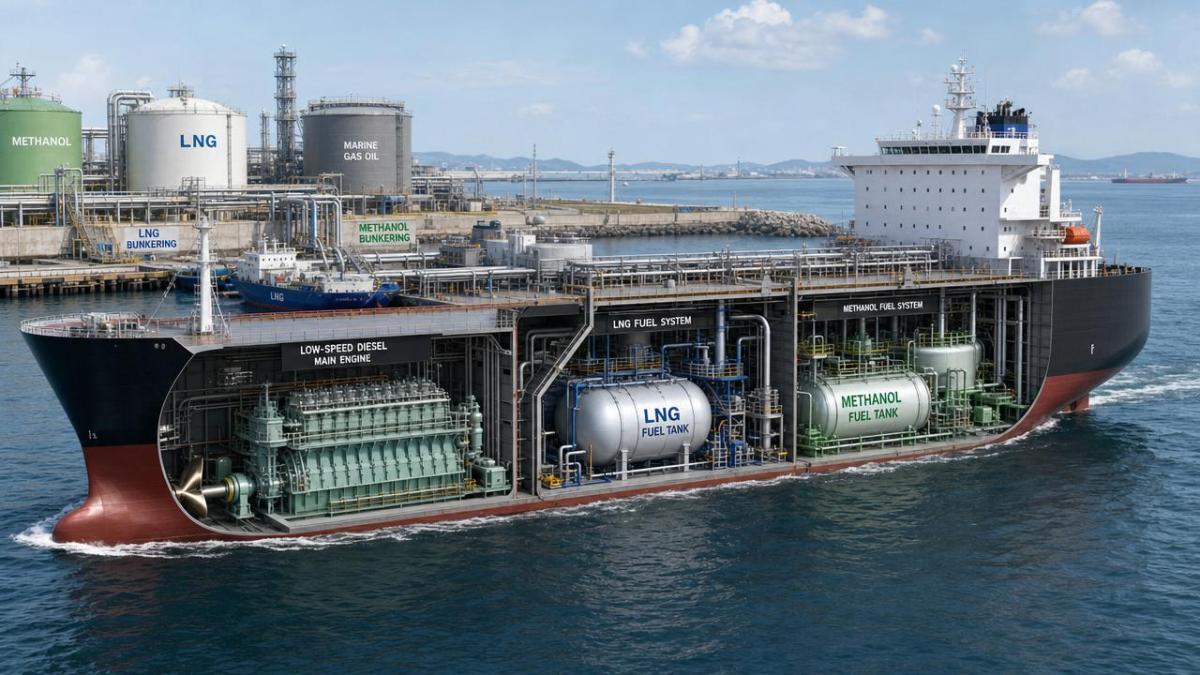
Conventional two-stroke low-speed diesel remains the reference case for many deep-sea newbuilds because it offers proven reliability, mature service networks, high thermal efficiency, and lower initial capital cost than many alternative-fuel systems.
For finance approvers, its main strengths are predictable maintenance planning, established crew familiarity, and strong global fuel availability. These factors support operational continuity and reduce near-term execution risk during fleet expansion or replacement programs.
However, the apparent simplicity of conventional diesel can hide future cost pressure. Exposure to tightening IMO carbon regulations, possible regional fuel taxes, and customer decarbonization demands may erode the attractiveness of a pure fossil-fuel pathway.
There is also asset-life risk. If a vessel is expected to trade well into the 2030s or beyond, a conventional design without fuel-flexibility may require midlife modification, speed restrictions, or accept weaker resale demand compared with transition-ready alternatives.
LNG propulsion: fuel savings potential with infrastructure and methane-risk complexity
LNG propulsion has appealed to many shipowners because it can deliver lower sulfur emissions, lower particulate matter, and often competitive fuel economics when LNG supply is available at scale. For some segments, this improved near-term compliance positioning.
From a finance perspective, LNG can make sense when route certainty is high, bunkering infrastructure is dependable, and the owner expects fuel spreads versus marine gasoil or very low sulfur fuel oil to remain favorable over time.
But LNG is not a simple savings story. It adds tank complexity, cryogenic handling requirements, higher installation cost, and potential cargo-space tradeoffs. Methane slip also creates environmental and reputational concerns that can affect long-range carbon positioning.
Approvers should model LNG under multiple scenarios, not one base case. If fuel spreads narrow, carbon accounting tightens, or methane-emission scrutiny intensifies, the expected payback period can lengthen materially and alter project returns.
Methanol propulsion: strategic flexibility and carbon positioning, with efficiency and supply tradeoffs
Methanol-ready and methanol-fueled marine propulsion systems have moved quickly into serious consideration because they offer a relatively manageable fuel-handling profile compared with some other alternatives and fit many decarbonization roadmaps.
For finance teams, methanol’s appeal lies in optionality. It can improve future carbon readiness, align with charterers seeking visible transition pathways, and reduce the chance that a newbuild becomes commercially outdated too early in its service life.
The tradeoff is economics. Methanol generally has lower energy density than conventional fuels, which can increase storage requirements and affect range or payload design. Green methanol availability and long-term pricing remain uncertain in many markets.
That means methanol is often best justified not by immediate fuel savings alone, but by strategic value: improved contractability, compliance resilience, and lower probability of stranded-asset behavior in a tightening emissions environment.
Ammonia and other future fuels: promising for decarbonization, but difficult to underwrite today
Ammonia is increasingly discussed because it offers a potential zero-carbon fuel pathway at the point of combustion. In theory, this could support long-term compliance and align with ambitious fleet decarbonization commitments.
Yet for current finance approval, ammonia remains challenging in most mainstream newbuild cases. Engine maturity, safety systems, toxic handling protocols, crew readiness, and fuel infrastructure are still developing and can materially affect bankability.
Unless the vessel serves a highly strategic project, subsidy-backed program, or charter-supported green corridor, ammonia can be difficult to justify on a purely commercial basis today. The uncertainty discount remains significant.
For many investors, the more rational posture is to monitor ammonia readiness while prioritizing designs that preserve future conversion flexibility rather than paying immediately for a pathway the operating market may not yet support.
The hidden financial variables that often change the propulsion decision
In board reviews, propulsion comparisons can become distorted because headline engine capex is visible while secondary cost drivers are scattered across technical, operational, and compliance budgets. These hidden variables deserve explicit financial treatment.
First is fuel storage impact. Alternative fuels may require larger tanks or different tank placement, influencing cargo capacity, hull arrangement, and earning potential. A small payload reduction can outweigh expected fuel savings over years of operation.
Second is infrastructure dependence. A theoretically attractive fuel loses value if bunkering access is limited, creates schedule deviations, or forces procurement at unfavorable ports. Reliability of supply chain matters as much as nominal fuel price.
Third is maintenance and training. New marine propulsion systems often bring added spare-part requirements, crew familiarization cost, software support needs, and service-network dependency. These costs should be budgeted as recurring operational realities, not footnotes.
Fourth is off-hire and retrofit risk. If a propulsion choice is likely to require modifications for tanks, emissions systems, or engine updates during the first decade, the lost earning days may be as important as the capital invoice itself.
How to compare propulsion options using a finance-ready decision framework
The most effective evaluation method is a scenario-based total cost of ownership model. Finance approvers should require each marine propulsion systems option to be tested across fuel-price, carbon-cost, and utilization scenarios rather than a single assumed outlook.
A practical framework includes seven inputs: initial capex, annual fuel consumption, expected fuel spread, carbon compliance cost, maintenance burden, downtime probability, and residual value at likely sale or refinancing points.
It is also useful to separate certainty from speculation. Proven maintenance intervals and current engine pricing can be modeled with tighter confidence ranges. Future green-fuel pricing should be handled with wider sensitivity bands and explicit downside cases.
Finally, tie the technical choice to commercial strategy. A tramp-trading vessel, a liner asset with fixed routes, and a charter-backed LNG carrier may each justify different propulsion economics. The right answer changes when revenue visibility changes.
Questions finance approvers should ask shipyards, engine makers, and internal technical teams
Before approving a newbuild, finance leaders should press for concise answers to several commercially critical questions. These questions often reveal whether a propulsion recommendation is strategically sound or merely technically fashionable.
Ask what fuel-price spread is required for the option to outperform conventional diesel, and over what utilization level. Ask what happens if bunkering infrastructure underperforms in the first five years of operation.
Ask which compliance assumptions are embedded in the model, including carbon intensity rules, regional trading schemes, and probable customer emissions requirements. If these assumptions are weak, the business case may be overstated.
Also ask about retrofit pathways, not just day-one configuration. Can the vessel convert economically if fuel markets move differently than expected? Financial resilience often comes from preserving options, not from predicting one future perfectly.
A practical decision view: match propulsion strategy to asset life and earnings model
For many owners, the best decision is not to chase the most advanced fuel immediately. It is to select the propulsion strategy that best fits the vessel’s earnings profile, route certainty, and expected ownership duration.
If short- to medium-term cash discipline is dominant and regulatory exposure is manageable, conventional low-speed diesel may still be justified, especially when paired with efficiency upgrades and a credible future retrofit plan.
If the vessel will trade on routes with robust LNG access and stable utilization, LNG can be financially reasonable, provided methane-related risks and long-term carbon assumptions are treated conservatively rather than optimistically.
If charterer expectations, financing pressure, or decarbonization strategy matter heavily, methanol-ready or methanol-fueled designs may provide superior strategic value even when pure fuel-cost economics are less compelling in the near term.
Conclusion: the best marine propulsion systems decision is the one that protects long-term cash flow
For finance approvers, the right marine propulsion systems choice is rarely the one with the lowest build price or the most impressive technical narrative. It is the one that protects earnings, limits compliance shocks, and preserves future commercial relevance.
That requires looking beyond fuel price today. Evaluate full-life fuel economics, infrastructure certainty, carbon exposure, operational disruption, and residual value. A disciplined scenario model will usually outperform intuition or supplier enthusiasm.
In newbuild planning, propulsion is now a portfolio-risk decision as much as an engineering decision. Owners who frame it that way are more likely to secure resilient returns in a shipping market shaped by both fuel volatility and decarbonization pressure.
Last:NoneNext :NoneRecommended News
- Oct 03, 2026How South Korea and China differ in shipbuilding intelligenceShipbuilding intelligence South Korea vs. China: compare engineering depth, smart-yard scale, green propulsion, supply chains, and delivery risk for smarter maritime investment decisions.Author :

- Oct 02, 2026Where does intelligence deliver value in the shipbuilding supply chain?Shipbuilding intelligence supply chain insights reveal how to reduce design risk, strengthen sourcing, meet compliance demands, and improve lifecycle value.Author :

- Oct 01, 2026How container AGV battery charging affects fleet availabilityContainer AGV battery charging directly shapes fleet availability. Learn how smart charging, battery health, reliable connectors, and data-led maintenance reduce downtime.Author :

- Sep 30, 2026What is shaping the terminal automation market outlook?Terminal automation market outlook: discover how throughput, labor, electrification, software integration, and retrofit strategies are driving smarter, more resilient port operations.Author :

- Sep 29, 2026How to prevent traffic conflicts in an AGV terminalAGV terminal traffic conflict prevention: discover zone reservations, crane coordination, queue control, and recovery practices for safer, smoother operations.Author :

- Sep 28, 2026How FPSO platform topside weight affects conversion feasibilityExplore how FPSO platform topside weight influences conversion feasibility, hull strength, stability, mooring, lifting, and lifecycle cost decisions.Author :

- Sep 27, 2026What drives downtime during FPSO vessel offloading?Discover what drives FPSO vessel offloading downtime—from weather and tanker readiness to equipment failures—and explore practical controls to improve safety and export reliability.Author :

- Sep 26, 2026When does an FPSO ship need a turret mooring system?FPSO ships need turret mooring systems when weathervaning, complex risers, harsh metocean conditions, or safe offloading demand stronger lifecycle operability.Author :

- Sep 25, 2026How to compare rig newbuild drilling equipment package bidsCompare rig newbuild drilling equipment package bids with confidence—evaluate scope, compliance, delivery, lifecycle cost, and support to reduce offshore project risk.Author :

- Sep 24, 2026What belongs in a rig newbuild drilling equipment package?Rig newbuild drilling equipment package essentials: explore hoisting, mud systems, BOP safety, controls, interfaces, and documentation for offshore readiness.Author :

- Sep 02, 2026What Buyers Should Verify Before Sourcing Monel Alloy Steel PlateMonel Alloy Steel Plate buyers should verify grade, standards, chemistry, traceability, and plate condition before ordering to avoid costly failures and source with confidence.Author :

- Aug 27, 2026Gas Turbine Output and Heat Rate: Which Specs Matter in Power ProjectsGas Turbine output vs heat rate: learn which specs truly drive power project value, fuel cost, and site performance so you can compare turbine offers with confidence.Author :